

Canada’s citizenship department has streamlined the citizenship by descent application process to assist applicants who wish to apply under the new citizenship rules but may not have all the necessary information readily available.
If you are uncertain about the Canadian heritage of a grandparent, you can simply indicate ‘unknown.’ Similarly, if you are unsure about a parent’s citizenship status, there is a provision to explain the situation.
Applying for Canadian citizenship by descent does not mandate an exhaustive collection of official documents spanning multiple generations. It is more about documenting your efforts to obtain supporting evidence and adhering to best practices when preparing your application.
Meeting the Requirements for Proof of Citizenship
The application typically requires documentation in three key areas:
- Verification of your identity;
- Evidence of your lineage to a Canadian ancestor; and
- Confirmation that the ancestor was indeed a Canadian citizen.
It is not mandatory for any member of your family lineage to possess a citizenship certificate or a Registration of Birth Abroad, which was historically used to record Canadian births outside the country.
Even if there is a missing certificate in your family history, IRCC allows for the submission of alternative forms of evidence to bridge the gap.
Exploring Alternative Documentation for Proof of Citizenship
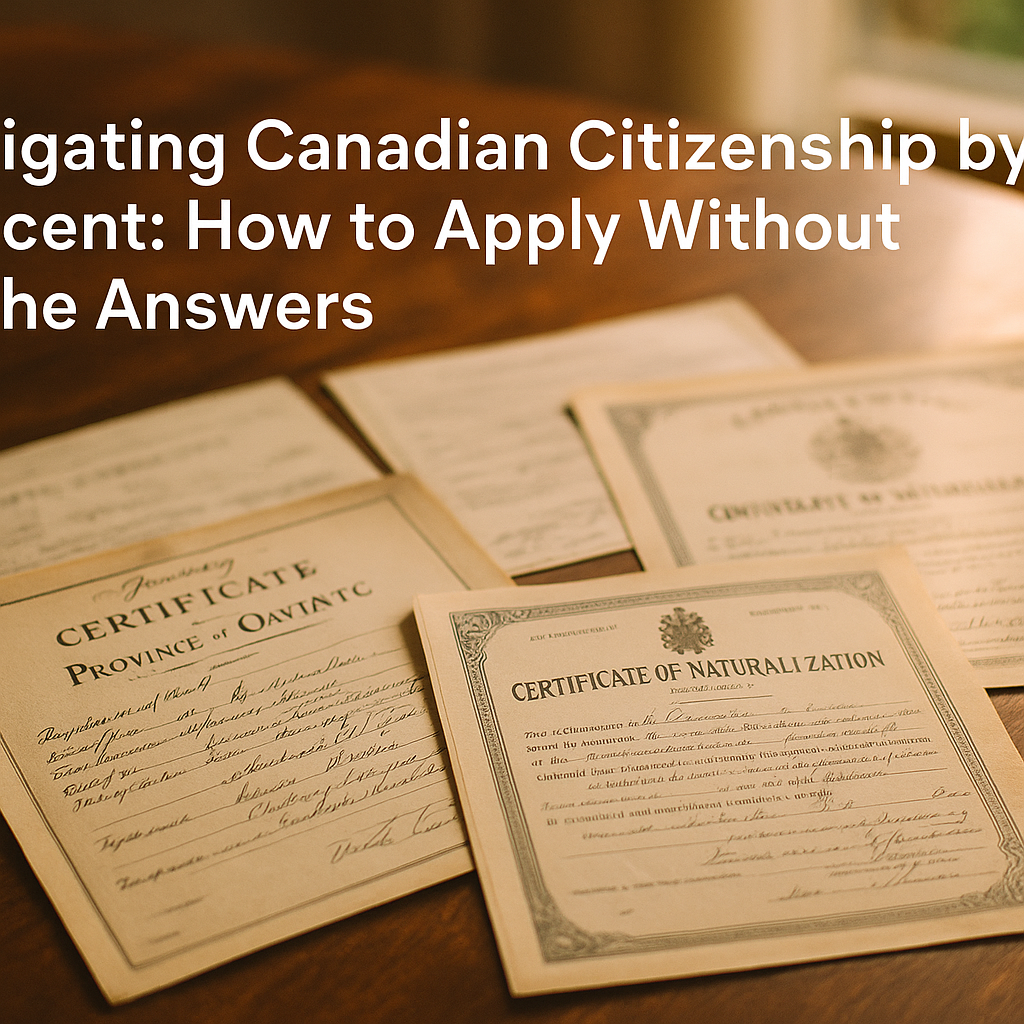
IRCC provides a list of acceptable alternatives to demonstrate your ancestor’s Canadian citizenship, including:
- Provincial or territorial birth certificates;
- Citizenship or naturalization certificates;
- Registration of Birth Abroad; or
- Retention certificate.
Additionally, historical documents like a British naturalization certificate issued in Canada or Newfoundland and Labrador can also be considered as valid proof of citizenship.
Furthermore, indirect evidence, such as a parent’s birth certificate indicating a Canadian grandparent, can further substantiate the Canadian lineage.