

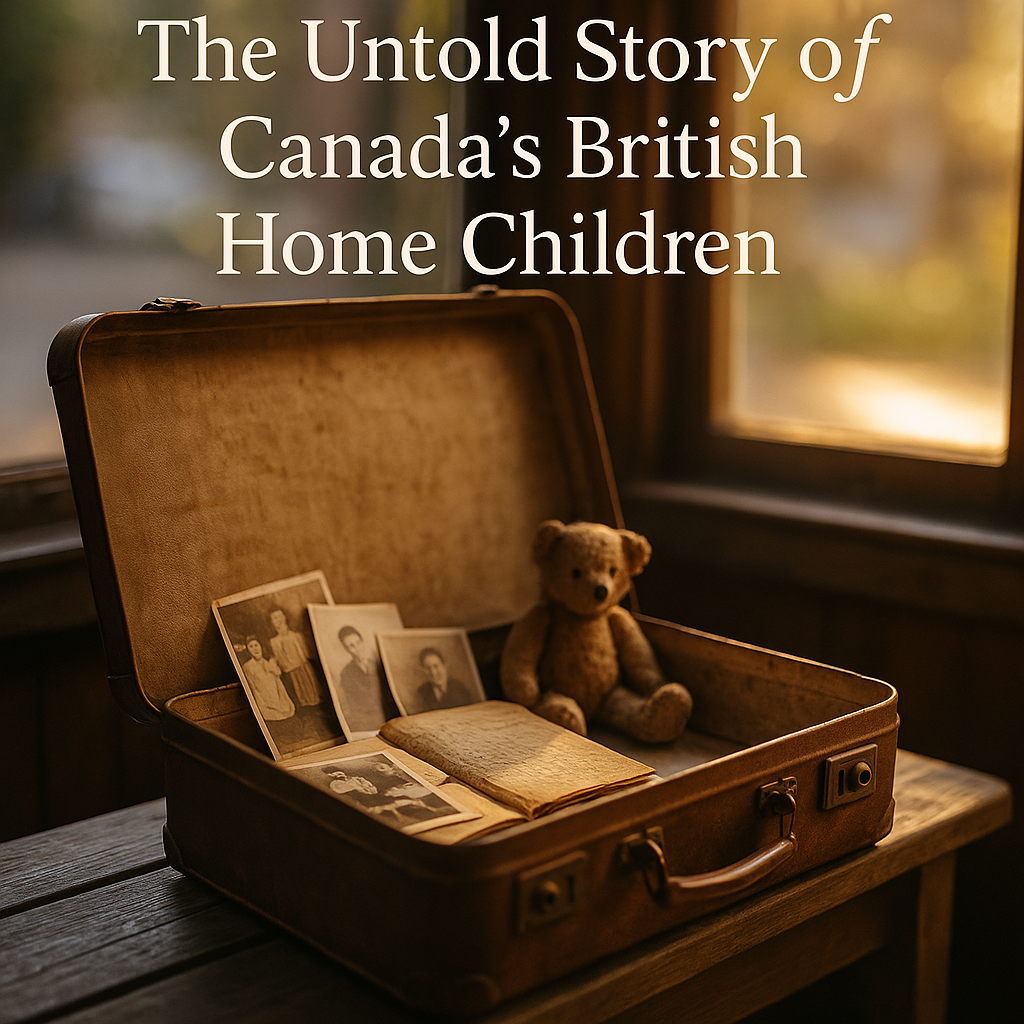
During the period from 1869 to the late 1930s, British agencies facilitated the migration of over 100,000 children to Canada, as reported by Library and Archives Canada (LAC). The UK’s National Archives, up to 1930, documented around 80,000 children sent to Canada.
Perhaps your family holds a similar narrative. An ancestor who journeyed across the Atlantic alone as a child, memories of a farm in Ontario, and tales of an orphanage in England or Scotland.
If this sounds familiar, your forebear might have been one of Canada’s British Home Children. Under Canada’s citizenship legislation, such family stories could signify your Canadian heritage.
In March 1889, a nine-year-old named Rob Greenhorn embarked on a voyage from Scotland aboard the S.S. Siberian. Accompanied by his older brother and 128 other boys, Rob had experienced the loss of both parents at a young age.
Rob’s entry in LAC’s Home Children records details his arrival in Halifax on March 26, 1889, followed by a journey to Fairknowe Home in Brockville, Ontario. Subsequently, he and his brother were placed on separate farms.
Years later, Rob’s granddaughter, Beth Greenhorn, uncovered her grandfather’s Home Child history in 2012 while working at LAC. She shared her discovery through a blog series for the archives.
A 2010 government release estimated that 3 to 4 million Canadians are direct descendants of former Home Children.
Many descendants residing outside Canada may unknowingly hold Canadian citizenship.
Exploring the Home Children
The Home Children derived their name from the journey they undertook: from an agency’s home in Britain to a receiving home in Canada. Various organizations, including charities, churches, and local boards, orchestrated these migration schemes to prevent vulnerable children in Britain from falling into poverty and crime. These organizations were referred to as sending organizations by LAC.
According to the UK’s National Archives, Maria Rye’s agency sent 3,623 girls to Canada, Annie Macpherson’s agency sent approximately 2,000 children, and Dr. Barnardo’s Homes facilitated the migration of 30,000 children between 1882 and 1939.
The majority of children were placed with rural families, with boys predominantly working on farms and girls serving as domestic workers. Critics of the time raised concerns about the schemes exploiting cheap labor with inadequate post-placement support.
While Rob Greenhorn had lost both parents, many Home Children had surviving family members…