

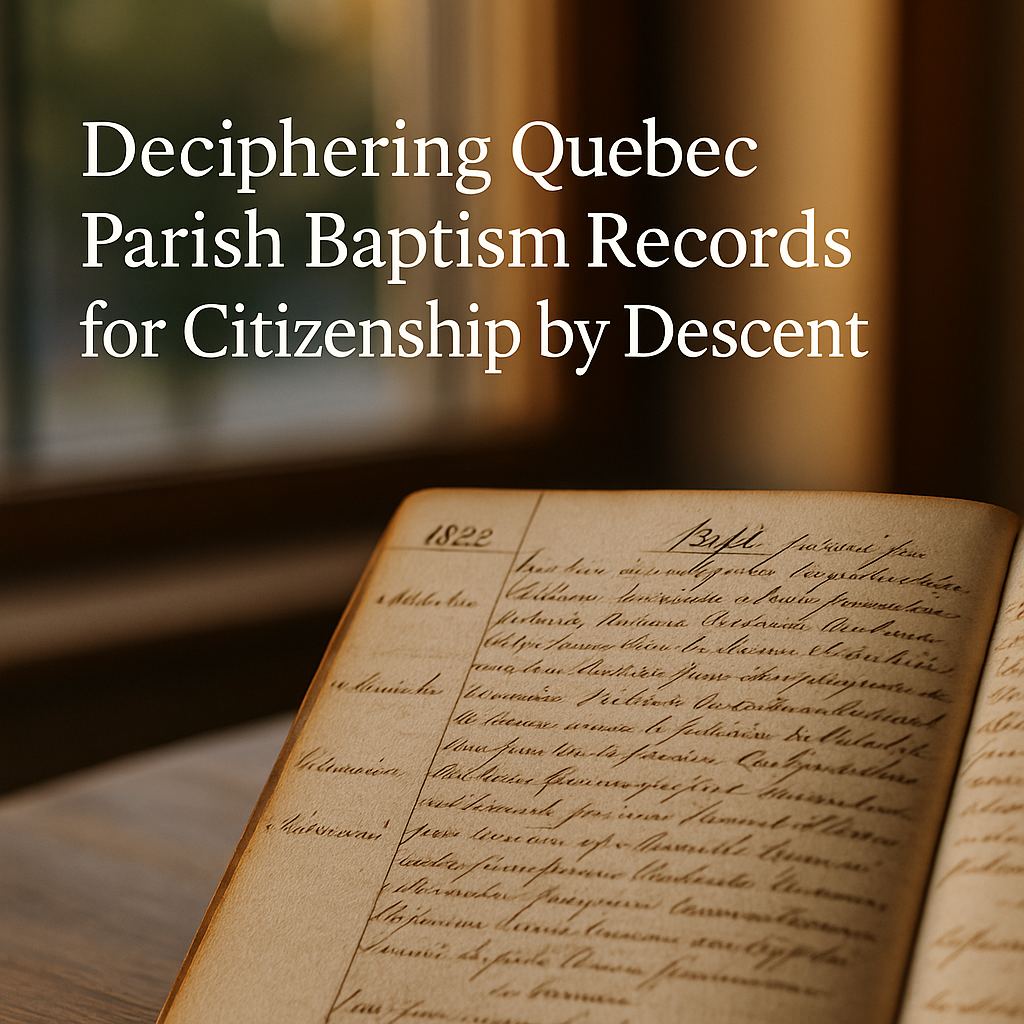
When looking at a Quebec parish baptism record, a crucial document for citizenship by descent claims, the 19th-century French cursive can seem daunting at first glance.
However, beneath the intricate handwriting lies a structured form. Priests in Quebec followed a standardized template when recording these entries.
Both the Church and civil authorities, initially the French Crown and later the province, established the rules. The information is presented in a consistent order across all acts, parish by parish.
Understanding the layout of the record can help you decipher most Catholic parish acts even without knowledge of French.
This article provides essential guidance for citizenship by descent applicants on how to interpret and read their ancestors’ baptismal records.
Begin with the Margins
The image above displays a page from a Quebec parish record dating back to 1822. Instead of a neat certificate, you will encounter pages like this during your search.
Focus on the left margin of each entry, where you will find a letter:
- B signifies baptême, a baptism.
- S signifies sépulture, a burial.
Priests often recorded both baptisms and burials in the same book. It is important to note the letter at the beginning of each entry, as it indicates the type of record you are examining.
The name next to the letter corresponds to the individual mentioned in the entry and can serve as a reference point.
The Six Elements, Presented Sequentially
Consider the last entry in the left column, featuring Ursule Gauthier. The subsequent acts on the page follow a similar pattern.
- The Date: Priests wrote dates in words, such as le dix-neuf de décembre mil huit cent vingt-deux, which translates to 19 December 1822.
- The Verb and the Name: Look for terms like baptisé or baptisée, followed by the name. For example, baptisée Ursule indicates the baptism of a girl.
- The Birth Reference: Phrases like Née de ce jour (born this day), née hier (born yesterday), or née aujourd’hui (born today) indicate the proximity of birth to the baptism date.