

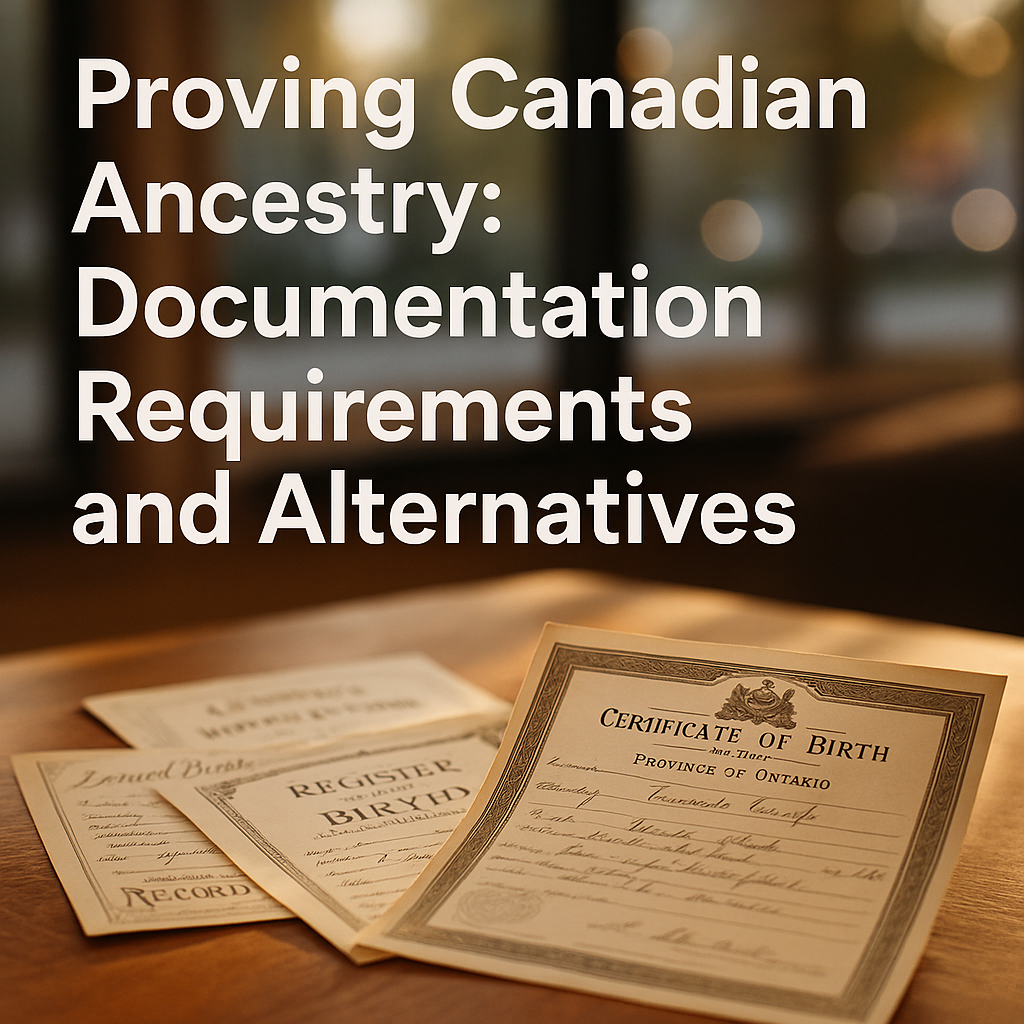
Finding and gathering the relevant documentation proving your Canadian ancestry can be a challenging task, especially for those tracing descent from ancestors born in the 1800s or early 1900s. Records from that era are often lost due to various reasons such as fire, flood, or gaps in record-keeping.
Civil birth registration was delayed or incomplete in some provinces. For instance, PEI had no civil registry before 1906, and Nova Scotia did not record births from 1877 to October 1908.
What Documentation Does IRCC Require to Prove Your Lineage
An application must establish an unbroken chain of documents linking the applicant to their Canadian ancestor and every generation in between. IRCC mandates that these documents be sourced from the original issuing authority, such as provincial vital statistics offices, civil registries, or archives.
Accepted documents by IRCC include a provincial or territorial birth certificate, Canadian citizenship or naturalization certificate, foreign birth certificate showing parent-child relationship, Certificate of Registration of Birth Abroad, Certificate of Retention of Canadian Citizenship, British naturalization certificate issued in Canada or Newfoundland and Labrador, or proof of British subject status or landed immigrant status in Canada before specific dates.
Accepted Alternatives When a Birth Certificate is Missing
In cases where a birth certificate is unavailable, IRCC allows alternative documents to demonstrate parentage and Canadian citizenship, provided they are from the original authority. These alternatives may include a hospital record of birth, a record from a physician or midwife who witnessed the birth, or other official documents.